Etsy

07/12/2010

Phoenix, Ginger, Copper, Silk and Terracotta

These pictures show simple spacers made from Phoenix, some I have struck and some I have left unstruck for comparison. For the beads that I struck, I allowed them to cool outside of the flame until they lost their glow and introduced them to the top flame again to bathe them in gentle heat. The colour of the struck beads is a rich soft orange opaque which was easy to achieve with a single strike. I am intrigued by the large variation in colour that can be seen in these images though comparing the struck and un-struck beads. I think that Phoenix would be an exciting glass to use for sculptural creations.


I made these sweet and simple little spacer beads from CiM Ginger. One of the larger beads has dots of silvered ivory stringer (sis) too. The fine silver leaf used to create the organic patterns and striations in the Effetre ivory stringer have not fumed or reacted with the base of Ginger at all which tells me that it would be a great glass to use if you were looking for a light and neutral non reactive base glass for your bead design.

This lovely necklace uses both struck and unstruck Phoenix with Ginger spacers to show a progression in both colour and tone. I have etched the surface of my spacers to compliment the wonderful hand crafted terracotta feature button by Tan Grey of tanofcourse. The bead and button elements have been tied together with a sumptuous sugar pink hand dyed silk ribbon by Diane Turton of SowZerE Designs. This necklace is a gift for a good mate of mine for Christmas, hope she likes it.
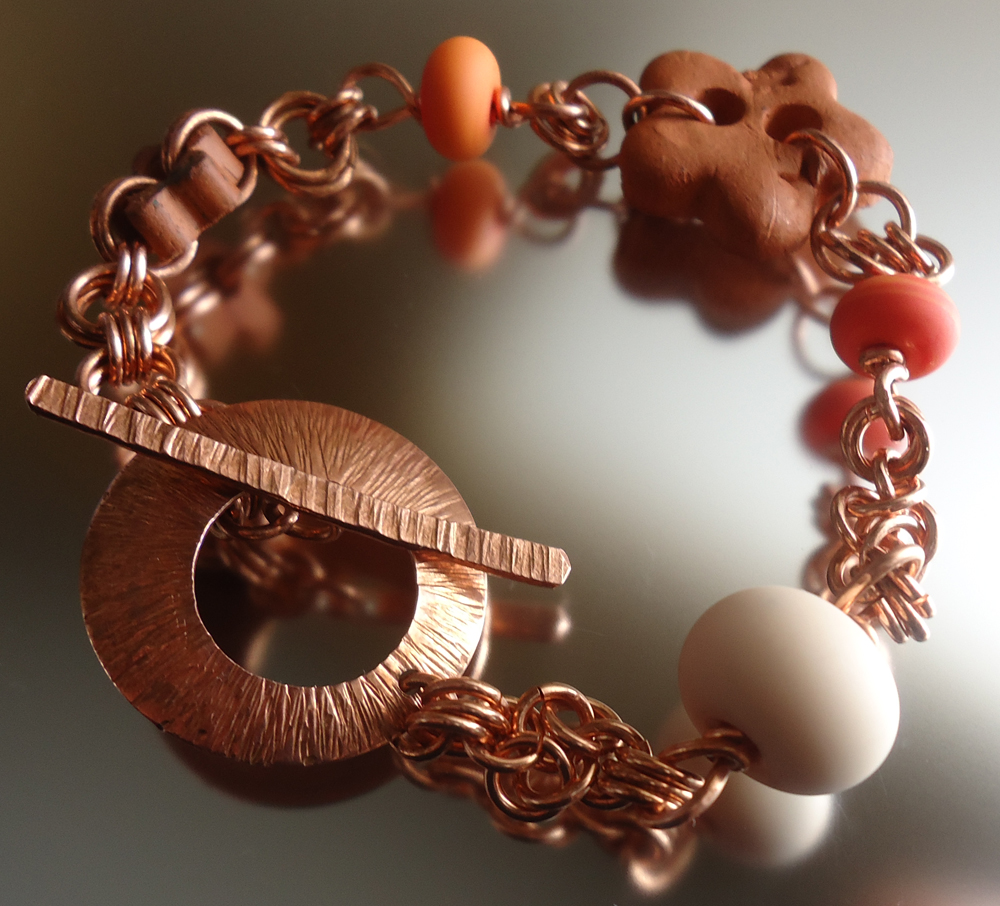


The last of my Ginger, Phoenix and terracotta Tan button creations is this bracelet in three parts. The gorgeous copper toggle and findings were made by George Harper who kindly put an all copper bracelet findings kit together for me.
I had never tried chain maille techniques before and so spent an informative afternoon browsing the fantastic M.A.I.L. (maille artisans international league) database for inspiration.


Jolene
Kitzbitz

Pretty Poi and little sis

Poi is a beautiful muted dark lilac. Either which way, this colour is lush.

My Poi test beads are made with silvered ivory stringer which is a widely used effect in lampwork bead making. Every lampworker has their own favourite recipe for making sis - mine is Effetre light ivory with silver leaf (as opposed to dark ivory with silver foil) the organic effects are quite subtle with this combination of metal and glass.

This bicone is made from Poi with Plum (opal) at its ends. The light spacers at the front are also Poi (worked quickly in the flame and without any fuming effects from the sis) the dark spacers behind are Evil Queen. It is nice to see a few of the CiM Purples together in one image, it shows how well all of these glasses work together.


These two diddy cone beads are just made from Poi and sis. You can clearly see in the pic some effects of silver fuming on Poi. The bead on the left shows a reaction line between the sis and Poi The bead on the right (made with stringer saturated with a greater amount of fine silver) shows that the whole face of the bead has been fumed and have a darker caramelised look.


My first necklace shows how soft and beautifully complimentary that Evil Queen, Poi and Ginger look when they have been acid etched. In the second necklace I have framed my Poi, Plum and sis bicone with some sunbaked beads by Julie Fountain of Lush Lampwork. In my third necklace I have left my Poi cone bead unetched as I really am a fan of that heavily fumed effect on this bead. All three of my necklaces feature hand crafted Sterling silver swan claps by George Harper of designed by george and very special silk ribbons, hand dyed in small batches by Diane Turton of SowZerE designs.

Jolene x
Kitzbitz

05/12/2010

A Blue and Siver Collection

A blue and silver collection by Michelle Madonna.

I have been working very hard to improve my photography and product presentation over the last few months and it is such a lovely treat to find yourself (or rather, your work) chosen and featured in an Etsy treasury by a fellow Etsian. A big thank you to Michelle Madonna of plantology for putting my seaglass beads front and center in her beautiful treasury.

Michelle's shop is jam packed full of incredibly beautiful images of her eco-chic plant arrangements. Here is a little teaser of what plantology has to offer.

Totally ZEN! Gorgeous Xerographica air plant in glass bowl, with coarse and beautiful grayish color leaves, all curly and curvy.

Zen Xerographica Arrangement In Glass Bowl

Jolene
Kitzbitz

04/12/2010

Soylent powder beads

I really like Soylent, it melts smoothly and has the most wonderful dark striations, much like a grass green version of the effect that you get from Effetre dark ivory. I found that Soylent is happy to be worked in quite a hot flame without shocking, devitting or pitting. It is a wonderfully unfussy glass. Soylent makes a nice dark base for enamels and furnace glass powders to sit on top of.


Jolene x
Kitzbitz

30/11/2010

Flutterby Sky - Fremen

The question is - Have I ever experienced Fremen pitting? The answer, for me at least is no. In the course of experimenting though I did fall in love with how soft and beautiful Fremen looks when encased with Messy Clear and then acid etched.

This bead is etched encased Freeman tab with butterfly Murrini by Ryan Turner.

I found that I had to treat Fremen very harshly by superheating for a prolonged period of time to get any sign of the surface sparkles and fizz that tells me the glass is boiling. Unlike with Pulsar though, there is no sign of surface pitting on my beads once they have cooled. Fremen is a wonderfully well behaved glass when I work it in a cool flame.

Tab focal with moth murrini by Charlotte Dakin-Norris.

Fremen is described as an opaque sky blue - perhaps this is why I couldn't resist teaming it with fluterby murrini. The dreamy look of these beads means that encasing and etching Fremen is a combination I am sure to come back to over and over again.


Jolene x
Kitzbitz

Messy testing - a few bit-some thoughts on Pulsar

My daughter Ruby says bit-some a lot at the minute, a bit-some Peppa Pig, a bit-some cuppee tea.....here are my bit-some thoughts on Pulsar.

Pulsar has a reputation for pitting. I have tested glass from two different batches and found that both did pit when I worked with them.

I tend to work fairly hot and it seems that Pulsar cannot stand up to prolonged heating in an intense flame without it boiling and bubbling up. This is what causes the pitting and tiny holes on the surface of some of my beads. To get the best from this beautiful transparent blue glass I found that I needed to melt Pulsar more slowly, turning my torch down a bit and working in the cooler tip of the flame. I think that Pulsar looks beautiful with blue highlight mica.


Pulsar also seems to be sensitive to a slightly reducing (propane rich) flame. This little spacer bead has a rusty/terracotta surface discoloration. I normally associate this sort of reaction to the chemistry of the flame to opaque rather than transparent colours.

Mostly though I think that Pulsar is made to be etched - it puts me in mind of tumbled seaglass and the ground surface of antique cobalt glass apothecary jar stoppers.

Jolene x
Kitzbitz

Blue Sangre

I have tested glass from three different batches of CiM Sangre, making a series of rough spacer beads in various different flame chemistry conditions, oxygen rich, neutral, slightly reducing and a strong orange reduction flame. The spacers formed in the reduction flame are the only ones to show any signs of turning blue at all – and then only in small patches.

None of these spacers have been struck, you can clearly see the transparent yellow areas on many of these beads which is what Sangre looks like before you reheat it to strike to red. I find though that Sangre does strike for me fully and evenly the first time that I bring it back to the flame. The picture to the left was taken indoors under artificial lighting and the glass looks darker, like toffee apple caramel rather than the vibrant and juicy red that it's true transparent shade. The image below was taken indoors also but is lit with a daylight lamp (10,000 lux) and looks much closer to true colour.

Next I made a large focal sized bead, using just Sangre, in a strong reduction flame. The results were very interesting; streaks of light grey/blue are clearly visible on the bead after kiln annealing. This bead is also totally opaque, the longer working and repeated striking has taken Sangre from unstruck two tone transparent and on to fully opaque which personally I like. It gives Sangre working properties unique in the 104 palette and is a very versatile glass


Jolene x
Kitzbitz

08/09/2010

Stone Ground Vs. Opal Yellow

Using EDP, Copper Green, Turquoise and Gold Pink together is a classic and well known combination for zingy glass reactions. I want to see if Messy Color Stone Ground will play well with these colours too.

I decided to make simple dotty beads using Effetre handpulled Copper Green, Effetre Dark Turquoise with Cranberry Pink, Effetre Opal Yellow and Stone Ground

Dots, dots, dots

Each pair of beads in the picture above have been made to the same pattern. The only difference is that the beads in the left row use CiM Stone Ground; the beads in the right hand row use Effetre Opal Yellow.

It is easy to draw some direct comparisons between the working properties of these two glasses, having used them side by side in this way. It is very difficult to gauge the difference between the relative reactiveness of the two by simply looking at the beads side by side after annealing. Once I had mixed the two sets of beads together I couldn't tell which were which anymore at all.

dots-2 dots-4

* I found that Opal Yellow is softer and slightly quicker to melt than CiM Stone Ground. This for me means that when used a as a base bead, it is slightly less easy to control and gravity shape.
* My particular batch of Opal Yellow was fairly shocky whilst the Stone Ground was very well behaved when introduced to the flame.
* The batch of Opal Yellow that I am using is a fairly dark one (some batches of this handpulled glass can be considerably paler) but it is still notably lighter in shade than CiM Stone Ground.
* Stone Ground appeared to be a striking colour, moving from pale creamy to caramel/tan when I heated the beads from cool to melt in raised dots.
* The Opal Yellow remained consistently pale without any signs of being a striking colour at all.

I find it very difficult to get a regular supply of Effetre Handpulled Opal Yellow from any UK stockist. Encouraged by the results from my dot bead tests I wanted to see if Stone Ground would solve my supply problems for finding a reliable, neutral, reactive base glass for use with powdered glass.

powder-detail-3 stone-ground-powder-beads

The powder beads on the left are ones that I made over a base of Effetre Opal Yellow earlier in the year. The beads on the right are the result of last evening’s playtime - powdered glass over Stone ground. I am very pleased with the results over Stone Ground so far, the reactions I got are every bit as dark, rich and as intense as those with Opal Yellow.

Stone Ground


Jolene x
Kitzbitz

02/09/2010

Striking Canyon

This focal is made from pure Canyon de Chelly, pressed with a wood grain effect texture plate and then burnished with fine silver leaf.

Wood grain effect focal with fine silver detail

This is a quite a large focal bead and I thought I might have trouble striking it to a constant colour all over but found that the only colour variations I can see are remnants of the silver leaf on the bead surface. The spacer beads have not been struck and make a surprisingly consistent match to the Effetre Opal Yellow twistie which wraps the complimenting Canyon/Maple tyre beads.

Wood grain effect focal with fine silver detail
I found that by warming this bead gently in the back of the flame after letting it become cool enough to be covered with the silver leaf allowed me to easily strike the Canyon de Chelly to its deeper shade.

Canyon de Chelly


Jolene x
Kitzbitz

Tuxedo Shimmer Stringer

Tuxedo can do such magical things when you throw silver and propane in the mix!

To create this shimmering iridescent effect I burnished some silver leaf on to a gather of Tuxedo and pulled stringer. Khaki was a fab choice as the base to decorate with my silvered Tuxedo stringer as I wanted to see how the silver would fume the Khaki and create a secondary reactive effect. Each bead has been wafted quickly through a reduction (propane rich) flame before just garaging to bring out the shimmering effects. The spacers are there as a comparison so that it easy to see the fumed areas on the Khaki glass caused by silver vapour fuming from the tiny fine silver droplets coating the tuxedo stringer.

Silvered Tuxedo stringer over Khaki

I wanted to try out silvered Tuxedo stringer on some other warm hued honey like colours next and so made these half and half Stone Ground/Maple rounds.

Silvered Tuxedo stringer over Stone Ground and Maple
As you can see neither the Maple nor Stone Ground has been affected by the silver content of the stringer in any significant way. As before, each bead has been wafted quickly through a reduction flame before just garaging to bring out the shimmering effects.


Fumed Tuxedo/Silvered Tuxedo stringer


The small disc beads in the pic below have been fumed with fine silver in a fairly propane rich reduction flame - nothing happened until I turned the oxygen right down. I found that the results are a little flat, dull and inconstant for me after seeing the beautiful shimmers, silver droplets and hints of iridescence that I have been able to achieve with the silvered Tuxedo stringer.


The large oval bead in this picture is a Tuxedo base, with silvered Tuxedo stringer, wafted quickly through a reduction flame.

I am a little bit disappointed with the results of pure fuming over a plain base of Tuxedo, perhaps this is simply due to my inexperience with the fuming technique as there is definitely an evident reaction between fine silver and this glass. For me less is more when it comes to throwing silver at Tuxedo and so although I won't try fuming it again, I will definitely be making more silvered stringer.

Jolene x
Kitzbitz

12/08/2010

Twistie eye candy


twists-blue, originally uploaded by kitzbitz art glass by Jolene.

I am getting the hang of blogging directly from Flickr - very handy, especially as I like my blog to be picture rich and not so very wordy. Here are some yum-scrum pics of my hand pulled twistie cane - bright and full of potential for lampwork bead beautifulness.


twists-orange twists-green twists-purple
Kitzbitz

11/08/2010

Lady Garden Beads

It might seem just a little bit naughty – or perhaps even out and out attention seeking, to be taking a perfectly pretty handmade glass bead and giving it a vadge badge.
I love making these, exactly because they are cheeky and to some tasteless, but to me they empower. Wear a Yoni with pride I say. I think that being 7 months pregnant has some part to play in this outspokenness – so whatever you call yours here are some of mine.

Green with Envy Lady Garden Honey Dew Lady Garden side 3 Mermaid Lady Garden

Kitzbitz

10/08/2010

Lost in Space

The kiln fairy left me this a couple of weeks ago - Lost in Space featuring a rocket murrini by Charlotte Dakin-Norris of Big Bang Beads

I gave it as a gift to my neighbours sisters son (who is 6) as he had big big eyes when he saw it. I have had it on good authority since that he sleeps with it under his pillow. I don't think a bead gets to be more treasured than that!

lost-in-space-5 lost-in-space-2